What does "super cotton-like" imitate?
Imitating cotton-fiber characteristics
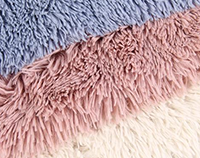
① Imitating the hairy feel and bulk
Polyester filament has high bundle cohesion and a smooth surface. To create a cotton-type hairy feel the fiber structure must be altered. Current routes to improve polyester bulk and hairiness include: using air-jet texturing to disperse and tangle the filaments into an irregular structure, or combining different raw materials to generate a three-dimensional crimped bulk.
Visually, air-jet textured cotton-like yarns have uneven linear density and variable hairiness; multi-material cotton-like yarns are more uniform, with hairiness developing mainly during finishing and without disturbing downstream processes.
② Imitating cotton's moisture absorption
Moisture management is improved by: using micro- or super-micro fibers to enlarge specific surface area and accelerate wicking; modifying the fiber cross-section to add moisture-transport grooves; or introducing hydrophilic groups onto the fiber.
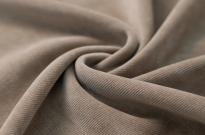
③ Imitating cotton's luster
To obtain cotton-like subdued luster the fiber surface must scatter light. Methods include surface modification to weaken reflection or absorb part of the light, and using micro- or super-micro fibers to enhance diffuse reflection.
Compensating for cotton's drawbacks
Polyester's good weather, light, heat and mildew resistance offsets cotton's poor durability. Polyester's high initial modulus gives stiffness and shape retention, remedying cotton's tendency to crease, distort and abrade.
Products can also be engineered for specific end-uses, some outperforming pure cotton. By choosing different hydrophilic agents and cross-sectional shapes, moisture absorption can be tuned to match different activity levels.
Weaving technology
① Fabric structure
Cotton-like appearance depends first on weave. Because the fine, profiled fibers wick well, weave design must suit the application—sometimes plain, sometimes twill—to maximize moisture transport.
② Warp/weft density
Densities must allow for fiber shrinkage during finishing so that after heat treatment the fabric develops adequate thickness and bulk.
Dyeing & finishing
Much of the cotton-like effect appears only after finishing. A pre-setting step is essential so fibers can shrink fully and develop bulk.
Typical flow: grey inspection → batching → scouring → hydro-extraction → pre-heat-setting → dyeing → hydro-extraction → post-heat-setting → decatizing → final inspection.
Soft stenter setting
While polyester's high modulus gives the fabric crispness that cotton lacks, excessive stiffness impairs comfort. A softening finish plus stenter setting, carried out after adequate shrinkage, enhances cotton-like hand.
Decatizing
Decatizing gives a fuller, softer hand and further improves simulation and wear performance.
Applications of super cotton-like products
Beyond looking and feeling like cotton, these fabrics offer dynamic heat-moisture comfort that often surpasses cotton. The fibers are widely used in knits, wovens, sportswear, casual wear, shirts, underwear, outerwear and home textiles.